


Think about the last time you needed a plumber, a good dentist or a shop that sells something special. You probably picked up your phone and asked.
Maybe you typed it into Google. Maybe you asked an app like ChatGPT or Gemini. Either way, you got a short answer with a few names in it — and you most likely called one of those names.
That short answer is now the shop window for your business. If you are not in it, many customers will never even know you exist. The good news: you can do a lot to get into it, and none of it is magic.
What has changed
A few years ago, Google showed ten blue links and people clicked around.
Today, Google often shows a short summary at the top of the page, written by its AI. Below that sits a small map with three local businesses. Many people stop reading there.
At the same time, more people ask AI apps directly: “Which café in Jaipur is good for a business meeting?” or “Who can build a Shopify store for my clothing brand?” The app reads websites, reviews and business listings, then writes a short answer with a few names.
So the question for every business owner has changed. It used to be “Am I on page one?” Now it is “Am I one of the names in the answer?”
Google says this plainly in its own guide for website owners: there is no special trick for AI answers. The same good basics that help you in normal search results are what help you appear in them.
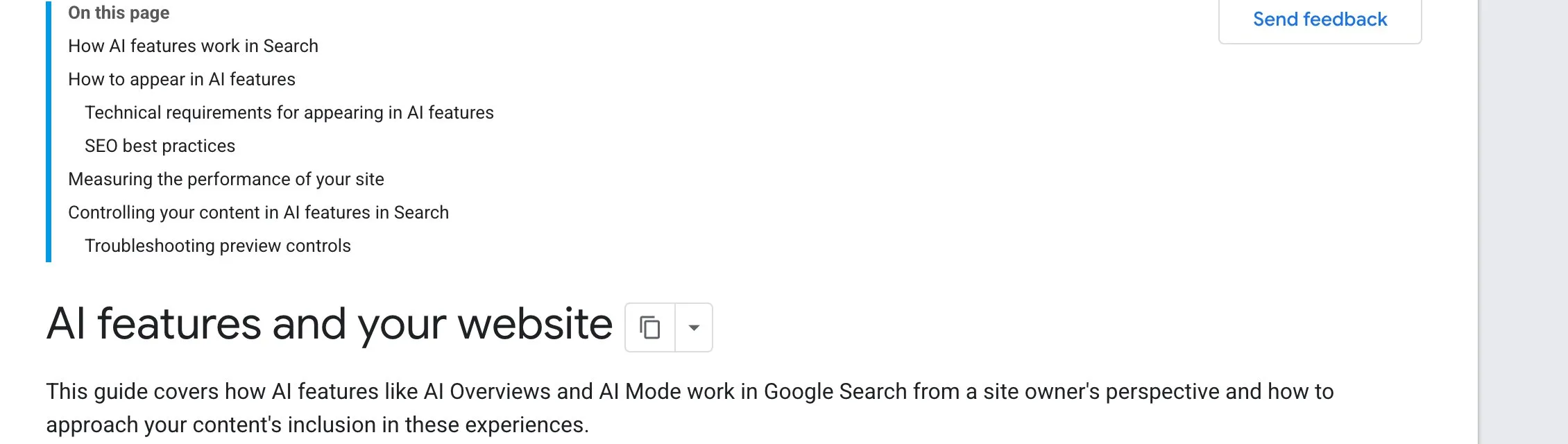
Google’s own guide, “AI features and your website” (Google Search Central). Screenshot taken 23 October 2026.
How these answers are chosen
Google, ChatGPT, Gemini and other AI apps all work in a similar way. Before they recommend you, they need to do three things:
- Find your website — and be able to read it.
- Understand it — what you do, where, for whom.
- Trust it — see that other people and other websites agree you are real and good.
If any one of these three is missing, you are left out. Let us go through them one by one.
Step 1 · Make sure they can find and read your website
This sounds obvious, but many small business websites fail here.
Check that Google knows your pages exist. Google has a free tool called Search Console. It shows which of your pages Google has saved. If your most important page — say, your services page — is not saved there, Google cannot show it to anyone, and neither can the AI tools that rely on Google.
Do not hide your words inside pictures. A beautiful banner that says “Best wedding photographer in Udaipur” looks good to people, but a computer often cannot read words inside an image. Write the important words as normal text on the page.
Do not block the readers. Every website has a small file that tells search engines and AI apps which pages they may read. Sometimes it is set up wrongly and blocks them by mistake. Ask whoever built your website to check it.
Make it fast on a phone. Most of your customers will open your website on a phone, often on mobile data. If it takes too long to load, people leave — and Google notices.
Step 2 · Make it easy to understand
Imagine a customer asks: “Who makes custom wooden furniture in Jodhpur?”
Now imagine two websites.
Website A opens with: “Welcome! Since our humble beginnings we have been driven by passion and excellence…” — three paragraphs before it says what they make.
Website B opens with: “We make custom solid-wood furniture in Jodhpur and ship it across India and abroad.”
Which one do you think an AI app will quote? Website B — because it answers the question in the very first line.
So:
- Put the answer first. The top of each page should say clearly what you do, where, and for whom.
- Then give the details. What exactly you offer, how long it takes, how to order, what happens next.
- Use the words your customers use. If they say “sofa”, do not only write “seating solutions”.
- Answer real questions. Write down the five questions customers ask you most on the phone. Answer each one on your website in a few simple sentences.
There is also a small piece of hidden code that tells search engines your business name, address, phone number and opening hours in a format computers read easily. You do not need to understand it — but ask your website builder whether it is there. It helps.
Step 3 · Earn their trust
Google and AI apps are careful. They do not want to recommend a business that might not exist or might be bad. So they look for proof.
Keep your details exactly the same everywhere. Your business name, address and phone number should be written the same way on your website, your Google Business Profile, Facebook, Instagram, JustDial and every other listing. If one says “Tonk Road” and another says “Tonk Rd., near the old bus stand”, it creates doubt. If an old phone number is still listed somewhere, fix it.
Complete your Google Business Profile. This is the free listing that shows your business on Google Maps. Fill in everything: the right category, your services, opening hours, real photos of your shop or team, and a short description that matches your website.
Ask for reviews — and reply to them. Reviews from real customers are one of the strongest signals there is. After a happy customer finishes a purchase, send them a short WhatsApp message with your review link. Reply politely to every review, good or bad. People read the replies too.
Be mentioned in other places. When your local trade association, a newspaper, a supplier or a partner mentions your business on their website, it tells Google you are real and respected. These mentions have to be earned honestly. Buying fake links or fake reviews can get your business punished and pushed down.
Step 4 · Show what only you know
The internet is now full of text that anyone — or any computer — can write in seconds. Pages that say the same as every competitor give an AI app no reason to pick you.
What makes you different is what you know from doing the work:
- A furniture maker can explain why sheesham wood needs seasoning before carving.
- A travel agent can say which months are too hot for a desert camp.
- A dentist can explain, simply, what really happens during a root canal.
Write that down. Add real photos of your own work, your own shop, your own team. Real detail is the one thing a generic website cannot copy.
Your checklist for this week
- Ask your website builder to check that Google has saved your main pages (in Search Console) and that nothing is blocking search engines.
- Rewrite the first two lines of your main page so they say what you do, where and for whom.
- Write down the five questions customers ask you most, and answer each one on your website.
- Compare your name, address and phone number on your website, Google, Facebook, Instagram and JustDial. Fix any that differ.
- Ask three happy customers for a Google review this week, with a short WhatsApp message and your review link.
Do these five things and you will already be ahead of most businesses in your area. If you would like help with any of it, we are on WhatsApp 24/7.
Sources
The official pages this guide is based on:


